تبدیل مدلهای بیناییـزبانی دوبعدی به برنامهنویس سهبعدی با بازخورد تکرارشونده
مقاله 3D-Prog پیشنهاد میکند مدلهای بیناییـزبانی دوبعدی، بدون بازآموزی، با قاببندی مختصات و بازخورد اجرایی برای کارهای سهبعدی بهکار گرفته شوند؛ این یک پیشچاپ با داوری مستقل تأییدنشده است و هزینه اجرا، وابستگی به مدل پایه و خطای داوری خودکار از محدودیتهای آن است.
فهرست مطالب
این معرفی بر نسخه پیشچاپ arXiv مقاله «Task-Adaptive Grounded 3D-Programmers Using 2D VLMs» (اکتبر ۲۰۲۶) تکیه دارد. متن مقاله پذیرش یا داوری تخصصی مستقل را ذکر نمیکند؛ نبودِ چنین اشارهای بهخودیخود دلیلی بر داوریشدن نیست، بنابراین وضعیت داوری مستقل آن تأییدنشده است. مسئله اصلی این است که مدلهای بیناییـزبانی دوبعدی در فهم معنا توانمندند، اما در حفظ پایدار مختصات، مقیاس، جهت و روابط اجزا در فضای سهبعدی مشکل دارند. نویسندگان بهجای گسترش ساده این مدلها به سهبعد، 3D-Prog را پیشنهاد میکنند تا یک VLM دوبعدی، دارایی سهبعدی و دستور زبانی را به برنامه اجرایی USD تبدیل کند.
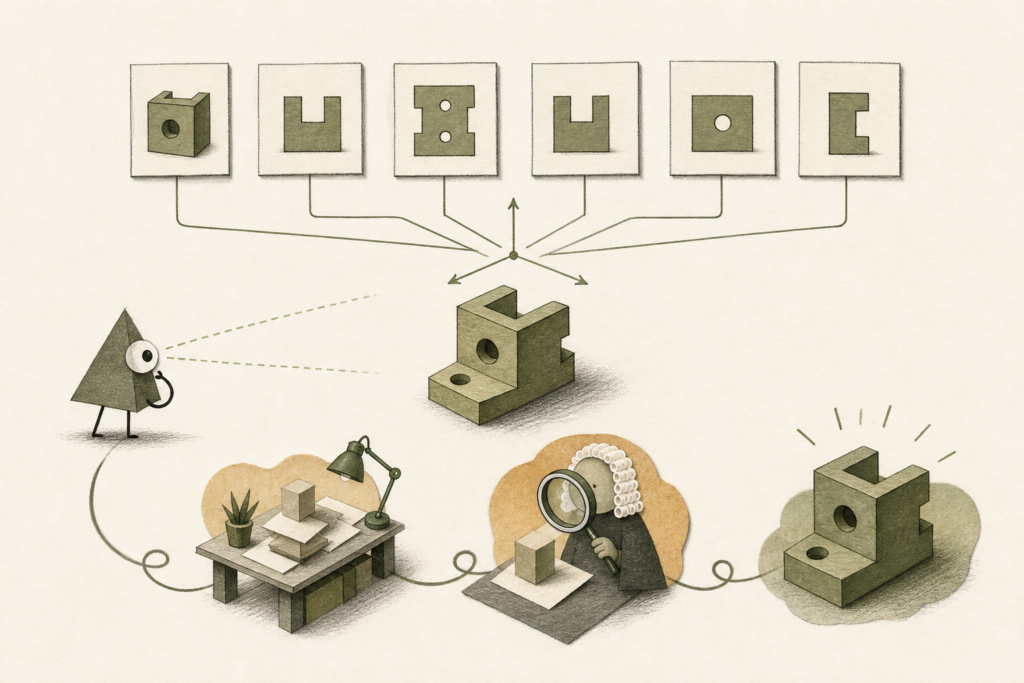
بخش نخست روش، «قاببندی مختصات متعارف» یا CCF است. دارایی ورودی با شش نمای قائم و یک نمای پرسپکتیو عرضه میشود؛ همه نماها مبدأ ثابت، محورهای X، Y و Z و نشانههای مقیاس دارند. هدف، استدلال در یک دستگاه اقلیدسی مشترک است، نه حدسزدن از یک تصویر. مقاله گزارش میکند حذف محورهای دیداری ابهام جهت، حذف نشانههای مقیاس ناسازگاری مقیاس، اتکا به پرسپکتیو اعوجاج متریک، و خروجی صرفاً پارامتری مرجع شناور ایجاد میکند.
جزء دوم، «بازخورد سازگار با وظیفه» یا TAF، حلقهای میان مدل و محیط اجرای پایتون است. VLM کد دستکاری USD و کد تحلیل ویژه وظیفه میسازد؛ این تحلیل میتواند نقشه چگالی، توزیع ارتفاع، پوشش بخشبندی یا خوشهبندی DBSCAN تولید کند. این خروجیها همراه نماهای CCF به مدل برمیگردند. یک VLM داور نیز با توجه به دستور، مقایسه دیداری و تحلیلها، وضعیت تکمیل، اطمینان، خطاها و پیشنهادهای اصلاح را اعلام میکند. فرایند تا تأیید داور یا سقف ۲۰ تکرار ادامه دارد.
آزمایشها تولید، فهم و استدلال سهبعدی را روی دادههای مصنوعی و اسکنهای واقعی، در مقیاس شیء و صحنه، میسنجند. معیارها شامل Chamfer، mAP، mIoU، خطای محور حرکت و دو مطالعه کاربر با چهار ارزیاب است؛ هر نتیجه میانگین پنج دارایی است. با ستون فقرات Claude، 3D-Prog در تکمیل شیء Chamfer برابر ۰٫۱۹، در تشخیص mAP برابر ۰٫۳۸، و در بخشبندی نمونه mAP برابر ۰٫۴۲ گزارش میکند. نسخه Kimi در پیشبینی محور مفصل، خطای میانه ۰٫۶۴ درجه دارد. در Scan2Sim، مدلهای پایه USD معتبری نساختند، اما 3D-Prog با ستونفقرات Claude و Kimi بهترتیب Chamfer ۰٫۰۸ و ۰٫۰۹ گزارش کرد.
آزمون حذف مؤلفهها از مکملبودن CCF و TAF پشتیبانی میکند: حذف CCF، mAP تشخیص را از ۰٫۳۸ به ۰٫۰۱ و Chamfer تکمیل را از ۰٫۱۹ به ۰٫۳۳ رساند؛ حذف TAF، Chamfer تکمیل را به ۰٫۵۸ بدتر کرد. در آزمون جابهجایی و چرخش روی یک دارایی تکمیل شیء، روش تا انتقالهای گزارششده و چرخش ۱۵ درجه Chamfer ۰٫۰۲ را حفظ کرد، اما در چرخش ۴۵ درجه افت آن به مدل پایه نزدیک شد. در مقایسه با GaussianVLM نیز دقت SQA3D از ۵۰٪ به ۶۰٪ و METEOR در Nr3D از ۰٫۲۲ به ۰٫۲۳ رسید. اینها نتایج تنظیم آزمایشی همین مقالهاند، نه حکمی کلی برای همه مدلها یا صحنهها.
محدودیتها مهماند: عملکرد به توان مدل پایه وابسته است و جزئیات ریز یا استدلال پیچیده همچنان دشوارند. داور همگرایی را میسنجد، نه درستی قطعی را؛ پس ممکن است پاسخ زیرِبهینه را بپذیرد. نمونه مکمل مقاله خطای برچسبگذاری معنایی را نشان میدهد که با وجود بخشبندی هندسی درست، اصلاح نشد. همچنین، زمینه دیداری VLM اندازه و جزئیات صحنه قابلپردازش را محدود میکند. میانگین اجرا ۱۱٫۴ تکرار و ۲۵۶ ثانیه روی یک GPU RTX 5090 با ۳۲ گیگابایت حافظه بود؛ بنابراین «بدون بازآموزی» بهمعنای بیهزینهبودن نیست.
This overview relies on the October 2026 arXiv preprint of “Task-Adaptive Grounded 3D-Programmers Using 2D VLMs.” The paper does not mention acceptance or independent peer review; the absence of such a mention is not itself evidence that review occurred, so its independent-review status is unverified. The central problem is that 2D vision-language models are strong at semantics but struggle to maintain coordinates, scale, orientation, and part relationships in 3D. Rather than naively extending these models into 3D, the authors propose 3D-Prog to turn a 2D VLM, a 3D asset, and a language instruction into an executable USD program.
The first component is Canonical Coordinate Framing, or CCF. An input asset is rendered as six orthographic views plus one perspective view; every view includes a fixed origin, labeled X/Y/Z axes, and metric scale marks. The goal is reasoning within a shared Euclidean frame rather than guessing from a single image. The paper reports that removing visible axes causes orientation ambiguity, removing scale markings causes inconsistent scale, relying on perspective-only projections causes metric distortion, and purely parametric outputs cause a floating reference frame.
The second component, Task-Adaptive Feedback or TAF, is a loop between the model and a Python execution environment. The VLM generates USD-manipulation code and task-specific analysis code; this analysis can produce density heatmaps, height distributions, segmentation overlays, or DBSCAN clustering. These outputs are returned to the model alongside updated CCF views. A separate judge VLM then reports a completion status, confidence score, and diagnostic feedback (errors and suggestions) based on the instruction, visual comparison, and TAF analyses. The loop continues until judge approval or a cap of 20 iterations.
Experiments evaluate 3D generation, understanding, and reasoning on synthetic data and real-world scans at object and scene scales. Metrics include Chamfer distance, mAP, mIoU, motion-axis error, and two user studies with four evaluators; each reported result averages five assets. With a Claude backbone, 3D-Prog reports 0.19 Chamfer distance for object completion, 0.38 detection mAP, and 0.42 instance-segmentation mAP. The Kimi-backed version reports a 0.64-degree median articulation-axis error. In Scan2Sim, baseline models produced no valid USD outputs, while 3D-Prog with Claude and Kimi backbones reported Chamfer values of 0.08 and 0.09, respectively.
Ablations support the complementary roles of CCF and TAF: removing CCF dropped detection mAP from 0.38 to 0.01 and worsened completion Chamfer from 0.19 to 0.33; removing TAF worsened completion Chamfer to 0.58. In a translation-and-rotation robustness test on one object-completion asset, the method held 0.02 Chamfer under the reported translations and a 15-degree rotation, but its degradation at 45 degrees approached that of the baseline. Against GaussianVLM, SQA3D accuracy rose from 50% to 60% and Nr3D METEOR rose from 0.22 to 0.23. These are results from this paper’s specific experimental setup, not a universal conclusion across all models or scenes.
The limitations are material. Performance depends on the capability of the underlying VLM, and fine-grained detail or very complex reasoning remains difficult. The judge module assesses convergence rather than guaranteed correctness, so it may occasionally accept suboptimal results. The supplementary case study shows a semantic-labeling error that persisted despite geometrically correct segmentation. Additionally, the VLM’s visual context limits the scene size and detail that CCF can process. Average runtime was 11.4 iterations and 256 seconds on an RTX 5090 GPU with 32 GB memory; "without retraining" therefore does not mean without computational cost.
پژوهشهای بیشتری بخوان
مقالات بیشتر درباره هوش مصنوعی و پژوهشهای تازه را ببین.